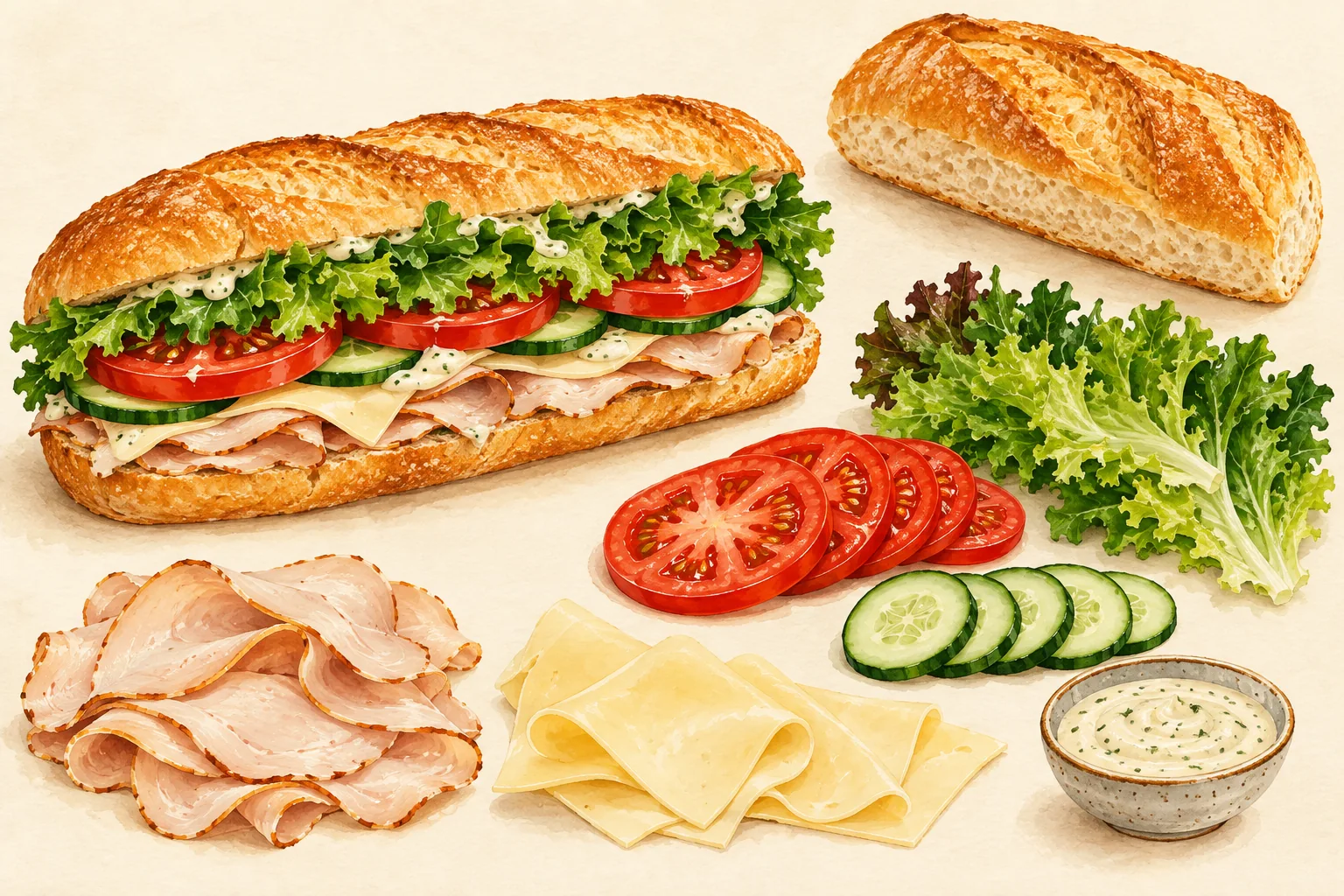
Nutrition information is most useful when it describes the sandwich in front of you. The recipe name, serving size, bread, sauce and additions all matter. Comparing a standard 6-inch recipe with a customized footlong does not produce a meaningful result, even if both orders have the same main filling.
This guide explains how to read Subway Canada's nutrition and ingredient resources and how to keep your comparisons consistent. It offers general menu-reading help, not a medical diet plan. If you have an allergy or a health condition that affects food choices, use the current official information and advice appropriate to your individual needs.
Begin with the current Canadian documents
Use Subway Canada's nutrition page, which links to nutrition tables, an ingredient guide and allergy information. At our October 7, 2026 review, the linked file names identified September 2026 documents. Check the live page for replacements rather than assuming a saved copy remains current indefinitely.
Make sure the document is for Canada. A similarly named sandwich in another country can use a different recipe or serving. Search results can also surface older files long after a newer version has been published. The current official landing page is a better starting point than an isolated PDF found without context.
Keep the document's notes with the numbers. A table may describe a standard build with specific ingredients. If you record only the calorie value and omit those assumptions, you may later compare it with a different order without realizing the mismatch.
Match the serving before comparing numbers
Find the serving size and the recipe name first. Then read the nutrient information for that serving. Do not assume the most prominent number on a product page refers to every size offered in the customization screen. Confirm which selection is active before using it in a comparison.
If you are comparing two sandwiches, place them on the same basis wherever possible. Two standard 6-inch recipes are a clearer comparison than a footlong of one recipe and a smaller version of another. If different sizes are intentional, describe them clearly instead of presenting the difference as purely a recipe effect.
Include the rest of the meal when that is what you want to compare. A sandwich-only value does not account for a drink, cookie or side. Keep the individual figures visible so you can see which part changes the total, rather than treating the whole meal as if it came from the sandwich alone.
Build a comparison around your actual question
A person comparing portion sizes asks a different question from someone comparing sodium or an ingredient list. Decide which information matters to you before scanning every column. This keeps the exercise practical and reduces the temptation to label one sandwich universally better from a single number.
| Your question | Compare on this basis | Avoid this shortcut |
|---|---|---|
| Which standard recipe has less of a nutrient? | Same size and documented build | Comparing different customizations |
| What changes with my addition? | Current information for that ingredient | Inventing an exact adjustment |
| What is in the meal? | Sandwich plus the selected extras | Leaving the drink out of the comparison |
If the available data cannot answer the question, keep the limitation visible. A precise-looking estimate can be less useful than acknowledging that the standard recipe no longer matches your customized order. Ask the restaurant or official support where to find the relevant information.
Customization can change more than one thing
Changing bread, adding cheese, requesting extra protein or choosing another sauce can alter the composition of a sandwich. A standard nutrition entry should not be presented as an exact value for all of those variations. Keep track of which changes you made before comparing the finished order with a published recipe.
Where the official resources provide ingredient-level information, use the listed serving assumptions. Avoid simply adding or subtracting numbers from unrelated products. A sauce entry and a sandwich entry may use different quantities or definitions, and a guess about the amount served does not become exact because it is written in a table.
A practical alternative is to compare documented standard builds first, then make a small number of deliberate changes. This gives you a clearer reference point. If exact nutrient management is medically important, obtain guidance suited to that need rather than relying on a generalized customization estimate.
Sauce is part of the recipe
Sauce can be easy to overlook because it occupies less visual space than bread or filling. Yet it is still an ingredient choice. Read the current description and ingredient information rather than treating all sauces as interchangeable or assuming a familiar name has the same formulation in every market.
If you prefer less sauce, ask what the restaurant can provide. Do not attach an exact nutrient reduction to an informal request such as “light sauce” unless reliable information supports that amount. Preparation is not a laboratory measurement, and a preference request does not establish a standardized serving.
For flavour planning, choose a sauce that supports the rest of the sandwich. This can make a simpler combination more satisfying to you without adding several competing ingredients. Our ingredient-led sandwich guide discusses flavour choices separately from nutrition claims.
Vegetable-led does not mean every dietary label applies
A sandwich built around vegetables can still contain cheese, an egg-based sauce or other ingredients relevant to a dietary restriction. A patty can have its own ingredient list. Read the complete recipe rather than deciding from the main filling or from the absence of visible meat.
Likewise, a wrap or bowl should not automatically be described as a lower-calorie or lower-carbohydrate option. Compare the actual serving and contents if that information is available. Changing the format can change portions and additions as well as bread, so the name of the container does not settle the nutritional comparison.
When a dietary label matters to you, define what you need to avoid and verify each relevant component. This is especially important if the order has several substitutions. A broad menu category is a browsing aid, not a certification of the finished meal.
Allergies require a preparation conversation
Subway's official allergen guidance warns that contact with other ingredients can occur during restaurant preparation. Removing one ingredient from a recipe therefore does not establish that the order is free from that allergen. Tell staff about the allergy before ordering and ask about the current information and preparation conditions.
Do not rely on a general guide, a photograph or a previous order to decide that a product is safe. Ingredients and processes can change. If the restaurant cannot provide the information needed for your situation, do not replace that uncertainty with a guess based on the sandwich name.
This site does not certify allergen-free meals or make individualized safety decisions. Its role is to direct readers to the relevant official information and explain the difference between a recipe comparison and an allergy-related assessment.
Use broader guidance without oversimplifying lunch
Canada's Food Guide provides a broader reference for everyday eating choices. A restaurant order can be considered within that wider pattern rather than assigned a universal good-or-bad label from one ingredient. Personal circumstances, preferences and dietary needs still matter.
For a practical menu comparison, keep your question narrow. You might compare two documented servings, identify a sauce ingredient or check the contribution of a drink. Clear questions lead to useful answers; trying to rank the entire menu on every possible nutritional dimension can obscure the choice you actually need to make.
Our 6-inch guide covers portion and spending decisions without treating size as a health prescription. The sides and drinks guide helps you include the rest of the meal. Together, they support a more complete comparison while leaving medical decisions where they belong.